Guide · Moisture testing

How do you know when screed is dry enough for flooring?

Not by the calendar. Drying estimates are planning tools — useful for programming a job, useless as proof. What determines whether a floor covering can go down is a moisture test carried out by the method, and against the criterion, that the screed, the adhesive and the finish require together. Walkable is not dry, and dry is not a date.

Based in Gerrards Cross, Buckinghamshire.

Quick answer

Benchmarks and product examples at a glance.

The figures below are a common industry benchmark and current published manufacturer examples, shown to illustrate how much criteria vary between systems. They are not universal limits, and they do not replace the requirement stated by the flooring, adhesive or screed manufacturer for the actual system being installed.

Common benchmark and current product-specific examples — not universal limits.
ContextFigure or statusImportant caveat
Common resilient-flooring benchmarkA series of sealed hygrometer readings not exceeding 75% RH.A widely used benchmark described in current F. Ball guidance as dry enough for most floor coverings — the finish, adhesive and system still govern.
Standard Gyvlon anhydrite exampleAround 0.5% moisture content by CM for impermeable coverings; around 1.0% for moisture-permeable coverings.Product-specific published guidance for standard calcium sulphate systems. Specialist Gyvlon E2C products work to different rules.
Cemfloor cementitious example2.5% CM or 75% RH for moisture-sensitive flooring, per current Cemfloor guidance.A cement-based figure. Do not transfer anhydrite percentages to it, or its percentages to anhydrite.
Electronic resistance / capacitance metersScreening and mapping only.Useful for finding wet areas and choosing test positions. Not a basis for laying a moisture-sensitive finish unless the flooring or screed system explicitly accepts the method.
The core point

Walkable is not the same as flooring-ready.

A screed becomes walkable, then takes light traffic, then takes following trades — and none of those milestones say anything about how much water is still inside it. A floor can carry a scaffold tower and still be far too wet to bond vinyl to. The moisture that matters for a floor covering is the moisture deeper in the section, which migrates to the surface after the floor is sealed by an impermeable finish.

That is why sealing a finish onto an untested floor is such an expensive mistake: the covering traps the remaining moisture, which then attacks the adhesive bond, lifts the finish or causes discolouration weeks after everyone has left site. Programme estimates — the kind set out in screed drying times — tell you when to plan the test, not whether to skip it.

Definition

What does 75% relative humidity actually mean?

It does not mean the humidity of the room. A subfloor hygrometer test works by sealing a small volume of air against the screed surface and isolating it from the ambient air, then leaving it until that trapped air reaches equilibrium with the moisture in the screed. The reading is the relative humidity of that confined volume — in effect, the humidity the screed itself produces.

Pointing an ambient hygrometer at the room, or waving a meter over the surface, measures something entirely different. That distinction is the single most common source of false confidence on site.

Current F. Ball guidance notes that BS 8203, BS 5325 and BS 8201 recommend hygrometer testing, and states that where a series of tests does not exceed 75% RH the base can be considered dry enough for most floor coverings — with 65% RH given for solid timber and the wood supplier consulted. BS 8203:2017, the current code of practice for the installation of resilient floor coverings, is a floor-covering standard: it sits alongside, rather than replaces, what the screed manufacturer says about its own material.

Methods

The main screed moisture test methods.

Different methods measure different things. A relative humidity reading and a percentage moisture content are not the same quantity, and converting between them is approximate and material-specific.

Sealed surface hygrometer (RH box)

What it measures. Relative humidity of a small confined volume of air brought into equilibrium with the surface of the screed.

Advantages. Non-destructive, repeatable, and the method most commonly referenced by floor-covering guidance. Current F. Ball guidance notes that BS 8203, BS 5325 and BS 8201 recommend hygrometer testing.

Limitations. Needs time to reach equilibrium and a genuine seal to the floor; results are affected by disturbance and by testing before equilibrium. Current Gyvlon guidance, citing BS 8204-7, notes RH testers are not accurate for calcium sulphate screeds at high moisture content above about 85% RH.

Where it is used. The default method for resilient coverings and the usual reference point for the 75% RH benchmark.

CM / carbide bomb (BS EN 13892-10)

What it measures. Moisture content of a sample by percentage, via the reaction of free water with calcium carbide in a sealed pressure vessel.

Advantages. Gives a direct moisture content figure, works on site, and is the method manufacturers such as Gyvlon point to where a definite value is required.

Limitations. Destructive; depends on correct sampling location and depth, sample preparation and operator technique. It reports moisture content, not relative humidity, and the two are not directly interchangeable.

Where it is used. Where a manufacturer specifies a percentage moisture content criterion, particularly on calcium sulphate screeds.

Oven drying / gravimetric

What it measures. Moisture content by weight loss, drying a sample to constant mass — current Gyvlon guidance references oven drying at 40 °C for calcium sulphate screeds.

Advantages. A direct, well-understood measurement of moisture content that can be used to establish or corroborate a value.

Limitations. Destructive, slower, needs laboratory or controlled conditions and correct drying temperature for the material. Not a same-hour site decision tool.

Where it is used. Corroboration, dispute resolution, or where a definite moisture content figure is required and CM is not appropriate.

Electronic resistance / capacitance meters

What it measures. An electrical property at or near the surface which correlates, imperfectly, with moisture.

Advantages. Instant, non-destructive and excellent for surveying a floor quickly to find wetter zones and decide where the definitive tests should go.

Limitations. Accuracy varies with material, depth of reading, surface condition, temperature and calibration. Current Gyvlon guidance treats surface-reading resistance meters as a rough wet-or-dry guide only; current Cemfloor guidance says confirmation should be by the specified hygrometer or carbide method before coverings are applied.

Where it is used. Screening and mapping — not as the definitive result unless the flooring or screed system explicitly accepts the method.
By material

Moisture testing sand and cement or cementitious screed.

For traditional sand and cement screed and cementitious flowing screeds, the sealed hygrometer test against the flooring criterion is the usual route to a decision, with the ≤75% RH benchmark the most frequently encountered figure for resilient coverings.

Manufacturers publish their own targets. Current Cemfloor guidance for moisture-sensitive flooring gives a final moisture target of 2.5% CM or 75% RH, and current Cemfloor technical guidance says electronic encounter meters may be used as a guide but confirmation should be by the specified hygrometer or carbide method before floor coverings are applied. Those are Cemfloor's figures for a cement-based screed — they are not a general cementitious rule, and the percentage associated with anhydrite systems does not transfer to them.

There is no reliable universal conversion between %RH and %MC for cementitious screeds. Test by the method the criterion is written in. Where drying speed is part of the programme, see fast-drying screed.

By material

Moisture testing calcium sulphate or anhydrite screed.

Calcium sulphate screeds behave differently and are tested differently. Current Gyvlon post-installation guidance states that electronic resistance meters reading from the surface downwards vary in accuracy and should be used only as a rough wet-or-dry guide; that RH testers are a British Standard test for most screeds, but that BS 8204-7 notes they are not accurate for calcium sulphate screeds at high moisture content above about 85% RH; and that for a definite value the BS 8204-7 recommendations should be followed — the CM carbide method to BS EN 13892-10, or oven drying at 40 °C — to establish percentage moisture content.

Gyvlon also publishes an approximate conversion for its own material: roughly 75% RH corresponding to about 0.5% moisture content, 80% RH to about 0.7%, 85% RH to about 1.0% and 90% RH to about 1.5%. Those correlations are approximate and product-specific — a guide to interpretation, not a substitute for the required test.

On criteria, published Gyvlon finishing guidance has given typical maximum CM values of around 0.5% for impermeable floor coverings and around 1.0% for moisture-permeable coverings. But the product matters: Gyvlon's specialist E2C products can allow bonded finishes at materially higher residual moisture under their own system rules. So the first question is never “what is the anhydrite limit?” — it is “which product is this, and what does its system require?” See liquid screed for how the families differ.

Depth and drying

Deeper sections dry more slowly.

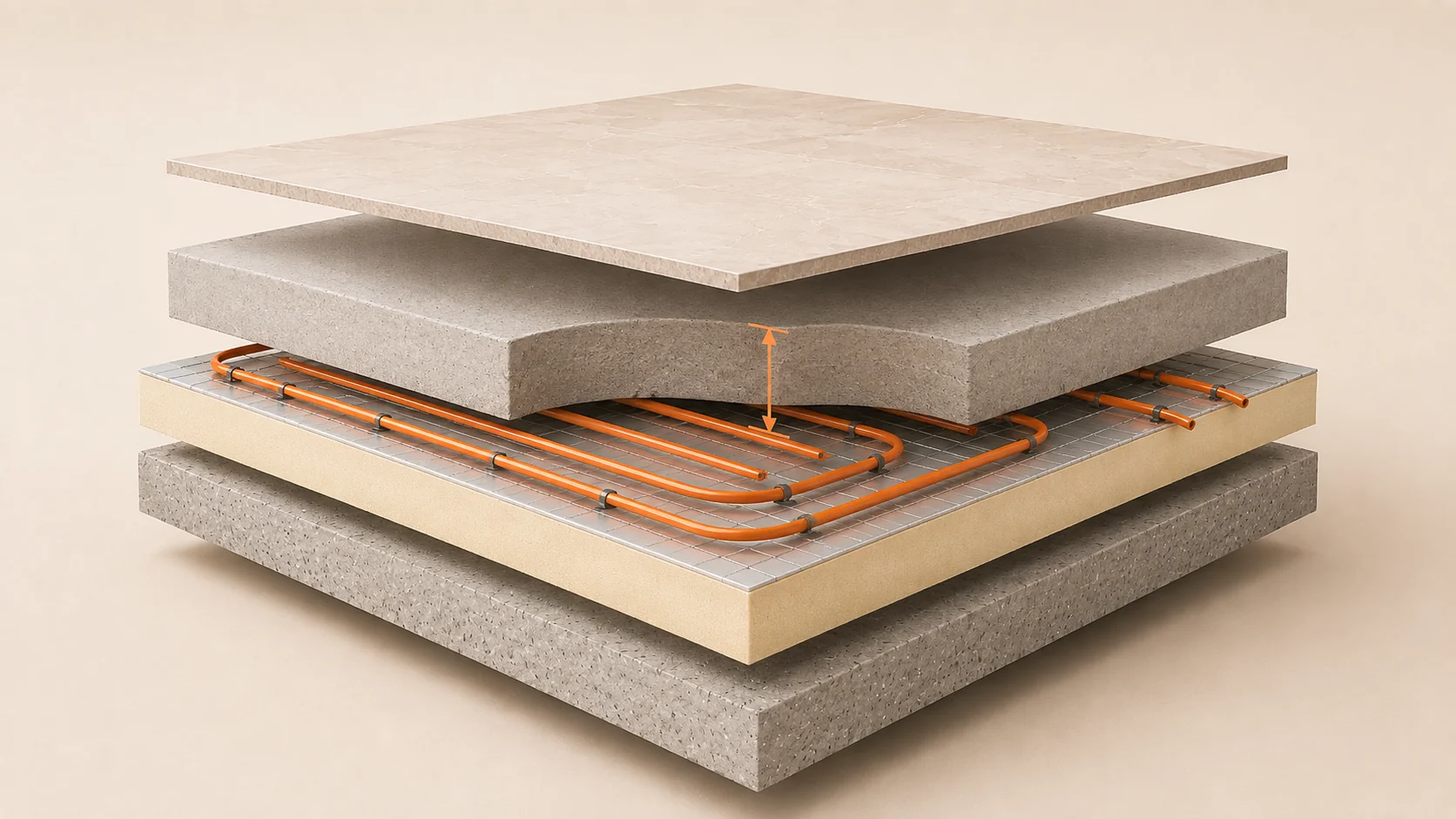
Technical sectional diagram illustrating how screed depth is measured above insulation and underfloor heating pipework.
Where to test

One reading does not describe a whole floor.

Moisture leaves a screed through its surface, so the depth of the section is one of the strongest influences on how long drying takes. A floor with a consistent nominal depth can still contain thicker zones where the substrate dips, and those zones stay wetter for longer.

That is why test positions matter as much as test method. Thick areas, perimeters, doorways, cold rooms and anywhere air movement has been poor are the places a floor typically fails first.

Depth and build-up are covered in the screed depth guide; both feed directly into how a floor should be programmed and where it should be tested.

Illustrative technical diagram · not a specific project

Underfloor heating

What changes with underfloor heating?

A controlled commissioning or heat-up cycle can assist drying, and on many projects it is part of the plan. Two conditions apply. First, it can only be done where the screed manufacturer's guidance permits it, and only after the initial curing period the screed requires has been respected — heating a young screed can damage it permanently. Second, the heating regime itself should follow the screed and heating system requirements rather than an improvised schedule.

Final moisture testing should then be carried out under the conditions and by the method the flooring and screed systems require. We do not publish a fixed “heating off for X days, then test” rule, because that period is set by the systems involved, not by a general convention. And a heated floor that feels warm and dry underfoot is still telling you nothing measurable. See screed over underfloor heating.

Caution

Why electronic moisture meters can mislead.

Handheld meters are genuinely useful, which is part of the problem — they produce a confident-looking number in seconds. What they actually read is an electrical property at or near the surface, and that property is affected by the material and its mix, the depth the instrument senses, surface condition and residual laitance, temperature, salts, reinforcement or pipework below, and the instrument's calibration for the material in front of it.

The surface of a screed also dries first. A floor can read dry at the surface while holding substantial moisture 20 mm down — which is precisely the moisture that will migrate upwards once an impermeable covering seals the floor.

Used properly, a meter is a survey tool: run it over the whole floor, find the wet zones, and put the definitive tests there. It becomes a definitive result only where the flooring or screed system explicitly accepts that method.

By finish

What moisture reading does vinyl, timber, tile or resin need?

In every case the answer comes from the manufacturer of the finish, adhesive or system being installed. The notes below are context, not criteria.

Vinyl and resilient coverings

Commonly worked to the ≤75% RH hygrometer benchmark unless a manufacturer-approved moisture-management or surface damp-proof system changes the requirement. The adhesive manufacturer's data sheet is the controlling document.

Timber and wood flooring

Typically tighter than resilient coverings. F. Ball's current guidance gives 65% RH for solid timber while advising that the wood supplier is consulted. Timber also has its own moisture-content and conditioning requirements of its own, so the flooring manufacturer sets the substrate criterion.

Tiles

Varies with the screed type, the adhesive and the system. Cement-based adhesives on a cementitious screed are not the same proposition as bonding to a calcium sulphate screed, and some proprietary early-to-cover systems change the criteria entirely. See our guide to preparing screed before tiling.

Resin flooring and resin screed

Resin systems require substrate moisture assessment as part of the system, and depending on the readings and the specification may require a surface damp-proof membrane or moisture-tolerant primer. The resin system manufacturer sets the allowable readings and the preparation.

For the substrate side of tiling, see preparing screed before tiling. For resin systems, see resin flooring and resin screed.

Remedies

What if the screed is still too wet?

First, do not treat the failed reading as an obstacle to be argued around. It is information, and it is cheaper than a failed floor.

The practical options are: improve the drying environment with ventilation and air movement, and dehumidification where the building is closed enough for it to work; use the underfloor heating system as a drying aid where the screed manufacturer's guidance permits it and initial curing requirements have been met; accept a programme delay and re-test; or, where the substrate genuinely cannot reach the criterion in time, consider a moisture-management or surface damp-proof system.

That last option is product- and system-specific. These systems exist for substrates above normal flooring thresholds, but they are approved for defined conditions and readings, and installing one is not permission to ignore a wet substrate. The flooring or resin manufacturer sets the allowable readings and the preparation required.

What not to do: run direct-fired heaters into a closed building, force-dry a screed that is still curing, or lay a finish on the basis of a date. Rapid uncontrolled drying causes its own defects.

Sampling

Where should moisture tests be taken?

A single reading in the middle of the largest room is the classic way to pass a test and fail a floor.

  • Spread readings across the floor rather than relying on one test to speak for the whole area.
  • Include the thickest or deepest zones — depth drives drying, so those areas often lag behind.
  • Include perimeters, doorways, corners and anywhere air movement has been poor.
  • Include areas that look, feel or read wetter on a screening survey, and any area that was covered or protected during drying.
  • Include cold areas, north-facing rooms and spaces that have been closed up.
  • Avoid areas that are unrepresentative for the wrong reason — a recent spillage or a locally damaged patch — unless you are deliberately investigating them.
  • Record where each test was taken, so results can be repeated and compared rather than argued about.

How many tests, and how they are distributed, should follow the method and acceptance arrangements the project and the relevant standards set out for the covering being installed. Agree that with the flooring contractor before testing starts rather than afterwards — the same principle that applies to tolerances in BS 8204 screed standards. Deeper zones deserve particular attention; see screed depth.

Records

What should be recorded at handover?

  • Screed type and, where relevant, the specific product and manufacturer.
  • Installation date, and the date the screed became accessible.
  • Nominal and, where known, average depth, plus the build-up (bonded, unbonded, floating, over underfloor heating).
  • Underfloor heating commissioning status and the heat-up regime used, if any.
  • Ventilation, temperature and site conditions during the drying period, as far as they are known.
  • Test method and device used, including model and calibration status where applicable.
  • Date and time of each test, and the equilibrium period allowed for hygrometer readings.
  • Test locations, described or marked on a plan.
  • Results as measured, including any readings that failed.
  • The criterion being tested against, and the finish, adhesive or system it comes from.
  • Who carried out the testing, and for which company.

A record like that turns a moisture question into a documented decision. It also protects everyone involved when a floor covering fails months later and the conversation turns to what was known and when.

Responsibility

Who decides the floor is ready?

The criterion comes from the specification and the manufacturer of the finish, adhesive or system being installed. The decision to proceed sits with the party installing that finish — in practice the flooring or tiling contractor, who should confirm the substrate meets their product and system requirements before bonding anything moisture-sensitive to it.

Our part is to give you what we know and to be straight about it: the screed type and product, the installation date, the build-up and nominal depth, the drying guidance that applies to that system, and the conditions the floor has been left in. That supports a proper test — it is not a substitute for one, and we do not certify a floor as ready for every covering.

If a programme depends on a floor being coverable by a particular date, raise it before the screed is specified rather than afterwards. Request a commercial quotation and send the programme with the drawings.

FAQs

Common questions.

What moisture level should screed be before flooring?

There is no single universal figure. The criterion comes from the floor covering, the adhesive and the screed system being used together. A widely used benchmark for resilient coverings is a series of sealed hygrometer readings not exceeding 75% relative humidity, which is the level F. Ball's current guidance describes as dry enough for most floor coverings. Product-specific criteria differ: current Cemfloor guidance for moisture-sensitive flooring gives 2.5% CM or 75% RH, and standard Gyvlon anhydrite guidance has historically given around 0.5% moisture content for impermeable coverings and around 1.0% for moisture-permeable ones. Always work to the criterion the specified system requires.

Is 75% RH dry enough for flooring?

For many resilient coverings it is the usual benchmark. F. Ball's current guidance states that where a series of hygrometer tests do not exceed 75% RH the base can be considered dry enough for most floor coverings, and 65% RH for solid timber, while advising that the wood supplier is consulted. It is a benchmark rather than a universal permission: some finishes, adhesives and systems require lower readings, and some manufacturer-approved moisture-management systems allow installation above it under their own rules. The finish manufacturer's requirement governs.

Can I use a handheld moisture meter on screed?

As a screening tool, yes — for finding wetter areas and deciding where to place proper tests. As the basis for laying a moisture-sensitive finish, no, unless the flooring or screed system explicitly accepts that method. Current Gyvlon guidance is that electronic resistance meters reading from the surface downwards vary in accuracy and should be used only as a rough wet or dry guide, and current Cemfloor technical guidance says electronic encounter meters can be used as a guide but confirmation should be by the specified hygrometer or carbide method before floor coverings are applied.

What is a carbide bomb or CM test?

The CM test — the carbide method, covered by BS EN 13892-10 — measures moisture content directly. A sample is taken from the screed, crushed, weighed and sealed in a pressure vessel with calcium carbide, which reacts with free water to produce gas; the resulting pressure is read as a percentage moisture content. It is destructive, requires care and correct sampling depth, and gives a moisture content figure rather than a relative humidity figure. Current Gyvlon guidance points to the CM method or oven drying at 40 °C where a definite moisture content value is needed for a calcium sulphate screed.

What moisture content should anhydrite screed be?

It depends on the specific product and the covering. For standard Gyvlon calcium sulphate systems, published finishing guidance has given typical maximum CM values of around 0.5% for impermeable floor coverings and around 1.0% for moisture-permeable coverings. Those figures are product-specific and should not be applied to cementitious screeds. Specialist products change the picture: Gyvlon's E2C range can allow bonded finishes at materially higher residual moisture under its own system rules, which is exactly why the actual product has to be identified before a criterion is chosen.

What moisture content should Cemfloor be?

Current Cemfloor guidance for moisture-sensitive flooring gives a final moisture target of 2.5% CM or 75% RH. Cemfloor is a cement-based flowing screed, so the roughly 0.5% CM figure associated with standard anhydrite systems does not apply to it. As always, the flooring manufacturer's requirement for the specific adhesive and covering sits alongside the screed manufacturer's figure, and the stricter of the two governs.

Can underfloor heating be used to dry screed?

A controlled commissioning or heat-up cycle can assist drying, but only where the screed manufacturer's guidance permits it and only after the screed's initial curing period has been respected. Heating too early, or too aggressively, can damage the screed. The heating regime, and the conditions under which final moisture testing is then carried out, should follow the screed and flooring system requirements — there is no universal number of days of heating after which a floor is dry.

Who should moisture test a screed before laying flooring?

In practice the flooring or tiling contractor about to bond a moisture-sensitive finish confirms that the substrate meets the requirements of the product and system they are installing, because they are the party warranting that installation. Screeding.com can tell you the screed type and product, the installation date, the build-up and nominal depth, and the drying guidance that applies — that information supports testing but does not replace it, and we do not certify a floor as ready for every covering.

Start the conversation

Planning a floor around a covering date?

Send the drawings, the build-up and the programme, and we will set out the screed options and what each one means for drying and testing before pricing. For traditional sand-and-cement work, an indicative estimate takes a minute.