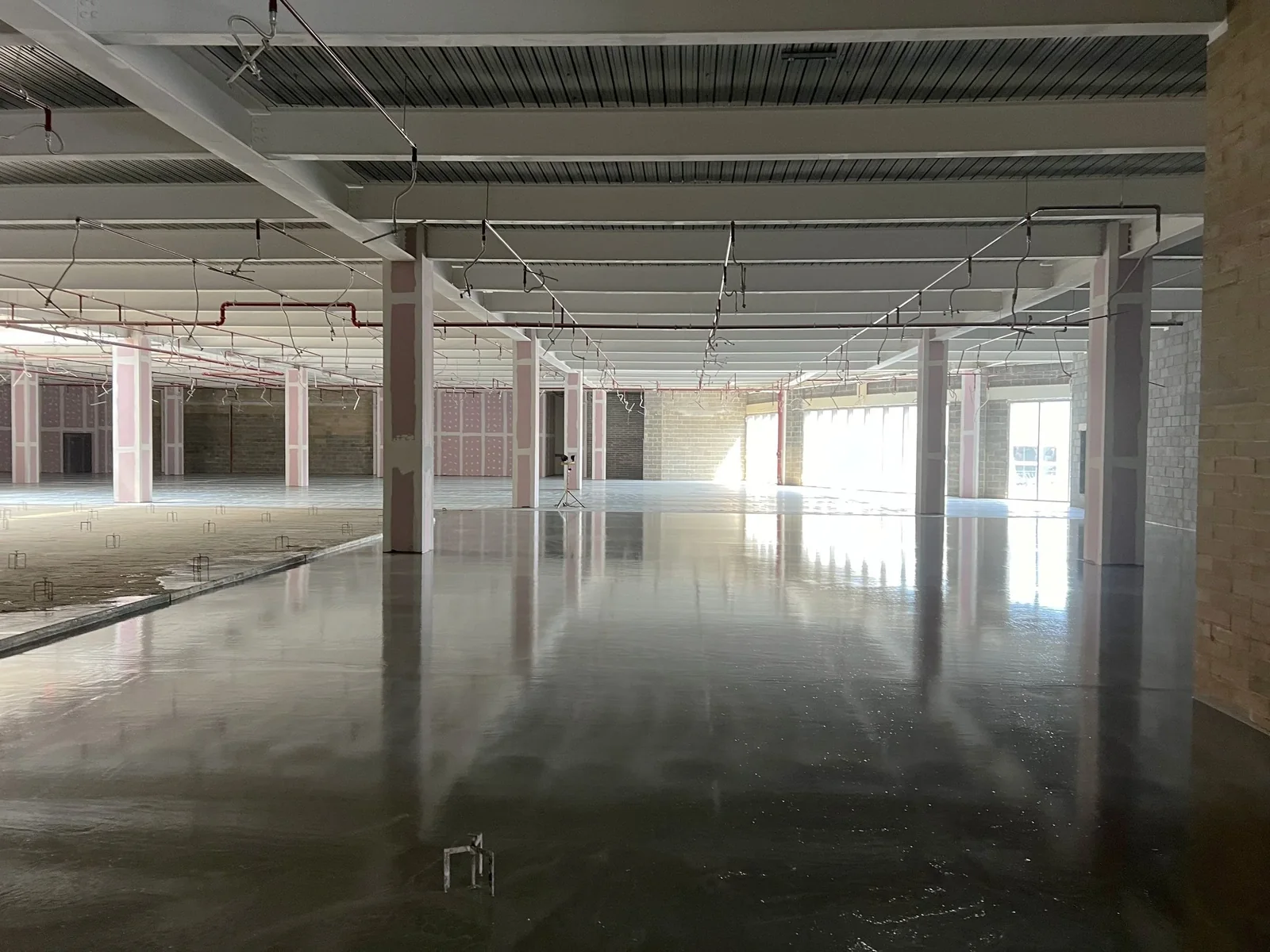
High Wycombe retail & leisure
At TeamSport High Wycombe, the 2,000m²+ package included flowing screed to the retail area and a bonded build-up and topping to the track. Each area had a different scope to review.
View projectArea is only the starting point. Depth, floor build-up, access and programme determine what your floor costs.
The figures on this page are historical budgeting examples, excluding VAT. They are not a current price list. Request a reviewed estimate or send drawings for a quotation.
Based in Buckinghamshire.
There is no single national rate for floor screeding, and any site that publishes one is simplifying heavily. The table below sets out historical Screeding.com project evidence so that a budget can be sanity-checked. It is not a current offer, not a tariff and not a quotation.
| Scenario | Historical figure | Context |
|---|---|---|
| Standard 4:1 sand and cement screed with reinforced polypropylene fibres | ≈ £19.50 – £21.00 / m² ex VAT | Larger, straightforward jobs with clear access and a standard internal installation. |
| Fast-drying / ceramic additive uplift | ≈ £4.00 – £5.00 / m² ex VAT additional | Historic additive uplift on top of the base screed. The system actually specified may price differently. |
| Smaller areas, roughly 25 – 34m² | Exceeded £40 / m² equivalent | Mobilisation and minimum charges spread over a small area push the equivalent rate up sharply. |
| Around 50m² | Mid-£20s / m² equivalent | Still above the larger-job band, but noticeably closer to it than a very small floor. |
These figures come from past project analysis. Historical records do not consistently capture depth, access, travel and every other input, so no safe fixed published price exists. Every project is reviewed before a figure is confirmed.
Screeding is not a purely material-driven trade. A large part of the cost of any visit is fixed: travel to site, collecting or taking delivery of materials, plant, crew time and set-up. Those costs barely change between a 30m² floor and a 150m² floor, so on a small area they dominate the per-m² equivalent.
That is why a small job can look expensive when reduced to a rate, even though the total figure is modest. On small work a minimum mobilisation charge normally applies.
These inputs interact. Two floors of identical size can price very differently once depth, access, build-up and location are known.
| Input | Why it matters |
|---|---|
| Area | Total m² is the single biggest driver, but the relationship is not linear — see the small-jobs section below. |
| Minimum mobilisation | Travel, collection, set-up, plant and crew time apply whatever the size of the floor. |
| Depth | Depth drives material volume, labour, programme and drying. An area figure without a depth cannot be priced safely. |
| Screed type | Traditional sand and cement, liquid screed and proprietary systems have different material and installation costs. |
| Additives | Fibre reinforcement, fast-drying and ceramic additives change the material cost and sometimes the method. |
| UFH and build-up | Pipe coverage, insulation, DPM, separating layers and bonded, unbonded or floating build-ups all affect the work. |
| Access and pumping | Restricted access, long pump runs, upper floors, parking, congestion and delivery constraints add time and cost. |
| Floor preparation | Removal of existing floors, levelling, priming, insulation and DPM work are separate from laying the screed itself. |
| Location and travel | Distance from the yard, travel time, congestion charging and site logistics affect the cost of getting to the floor. |
| Programme and complexity | Phased work, night work, multiple visits, several floors and tight sequencing all change what the job takes. |
Illustration: a 100m² floor
Volume (m³) = area (m²) × depth (mm) ÷ 1,000.
These depths illustrate quantity, not a specification. Figures exclude waste allowance. A 50% increase in volume does not mean a 50% increase in the quotation.
Calculate your screed volumeAt TeamSport High Wycombe, the 2,000m²+ package included flowing screed to the retail area and a bonded build-up and topping to the track. Each area had a different scope to review.
View projectThis example explains scope; no project price is published.
Highgate East: a multi-level installation covering 800m²+ per level.
Historical Screeding.com analysis of standard 4:1 sand and cement screed with reinforced polypropylene fibres showed approximately £19.50 to £21.00 per m² excluding VAT on larger, straightforward jobs — clear access, a standard internal installation and no significant preparation.
That band should be treated as historical evidence for budgeting. It is not a current offer, and it does not apply to small areas, restricted access, upper floors, phased work, unusual depths or projects needing preparation.
Where programme matters, a fast-drying or ceramic additive may be considered. Historically that uplift appeared at around £4.00 to £5.00 per m² excluding VAT on top of the base screed.
That is an example, not a rate card. The system actually specified for a project may price differently depending on product, depth, supplier and the follow-on floor finish. Fast-drying also does not mean instant — see screed drying times.
Liquid screed is not published here as a Screeding.com rate, because a single figure would be misleading. Plant and pump requirements, the specific product and supplier, depth, total quantity and the distance from the pump position to the floor all move the price materially.
Larger, open, well-accessed pours tend to be more efficient than small, awkward ones. Liquid screed work is priced through a quotation once the build-up, depth and site logistics are known. For a comparison of the two systems, see sand cement vs liquid screed.
Take two traditional sand and cement floors at the same depth, same build-up and same standard access. The only difference is size.
The visit still needs travel, materials collection, plant, a crew and set-up. Those fixed elements are shared across only 30m², so historically this kind of job worked out at more than £40 per m² equivalent, even though the total figure is small.
The same fixed elements are shared across far more square metres, and the crew works productively for longer once set up. Historically these straightforward larger jobs sat in the £19.50 to £21.00 per m² excluding VAT band.
Applying a large-job rate to a small floor will under-budget it, and applying a small-job equivalent to a large floor will over-budget it. Use a rate as a sense check, then get the floor priced properly.
This historical illustration is not a current offer. It is deliberately simplified and shows the shape of the relationship between area and rate, not the internal pricing method.
Area and total depth, if known.
Build-up, underfloor heating and finish.
Postcode, access and floor level.
Dates, phasing and drawings.
Request an indicative estimate for review · Send drawings for a quotation
The more of the following you can confirm, the tighter the figure can be. Anything unknown widens the range or triggers review.
For standard traditional sand and cement work with a known area and depth, use the estimate route. For specialist systems, preparation, restricted access, phased work, drawings or a bill of quantities, use the commercial quotation route. Every figure is reviewed before it is confirmed, and indicative figures are not a binding quotation.
The lowest headline rate may cover a different scope.
Confirm whether each quotation includes the stated screed system and quantity, installation, pumping or material handling, preparation, insulation and DPM, access and phasing, handover information and VAT. Mark anything excluded or provisional.
These are comparison checks, not a promise that every item is included in a Screeding.com package. The agreed quotation sets out the scope.
There is no single national rate. Historical Screeding.com analysis of standard 4:1 sand and cement screed with reinforced polypropylene fibres showed roughly £19.50 to £21.00 per m² excluding VAT on larger, straightforward jobs. That is historical evidence rather than a current offer or a universal tariff, and smaller or more complex jobs behave very differently.
Mobilisation is largely fixed. Travel, materials collection, plant, labour and set-up are broadly similar whether a floor is 30m² or 200m², so on a small area those fixed costs are spread over far fewer square metres. Historical examples in the 25 to 34m² range worked out at more than £40 per m² equivalent, while a 50m² example was around the mid-£20s per m² equivalent.
Yes. Depth drives material volume directly, and it also affects labour, programme and drying. A floor at 50mm and the same floor at 100mm are materially different jobs, which is why an area figure alone is not enough to price accurately.
Historically, a fast-drying or ceramic additive appeared at around £4.00 to £5.00 per m² excluding VAT on top of the base screed. That is a historical example only; the actual system specified for a project may price differently depending on product, depth and supplier.
Liquid screed is not priced from a fixed rate. Plant and pump requirements, the specific product, depth, total quantity and distance from the supply point all change the figure. Liquid screed work is priced through a quotation rather than a published rate.
All figures referenced on this page are excluding VAT. VAT is applied separately according to the project and the applicable rate.
No. Request an indicative estimate for review. The form collects project details and does not display an immediate or fixed price. Specialist systems, preparation, restricted access, upper floors, phased work, drawings or a bill of quantities use the commercial quotation route. A formal quotation is issued only after review.
They come from past Screeding.com project analysis. Historical data does not consistently record depth, access, travel and every other variable, so those figures are published as budgeting evidence rather than as a current price list or an offer.
Review the build-up, access, underfloor heating and floor finish programme for your project.
Request a reviewed estimate for traditional sand-and-cement work, or send drawings and specifications for a commercial quotation.